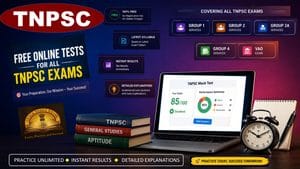
TNPSC Exams are conducted by the Tamil Nadu Public Service Commission (TNPSC) to recruit candidates for various posts in the Tamil Nadu state government. This page provides useful information about the latest TNPSC exams, including notifications, syllabus, exam pattern, important dates, and subjects to prepare.
Whether you are looking for TNPSC questions, a TNPSC free test, or reliable resources for TNPSC exam preparation, you can find topic-wise study and practice resources here. Our TNPSC online quiz and subject-wise test series can help you revise important concepts, assess your preparation, and practise questions based on the relevant exam syllabus.
Check the latest exam details below and use to plan your TNPSC preparation effectively.
✅ Practice TNPSC Quizzes (Free)
Latest TNPSC Exams
| Exam Name | Notification No. | Application Start Date | Application End Date | How To Apply |
|---|---|---|---|---|
| Combined Technical Services Examination (Interview Posts) | 08/2026 | 07.09.2026 | 06.10.2026 11:59 PM | View Details |
| Combined Civil Services Examination – II (Group II and IIA Services) | 07/2026 | 11.08.2026 | 09.09.2026 11.59 P.M | View Details |
| Combined Technical Services Examination (Diploma / ITI Level) | 06/2026 | 17.07.2026 | 15.08.2026 11:59 PM | View Details |
| Combined Civil Services Examination – I (Group I Services) | 05/2026 | 30.06.2026 | 29.07.2026 11.59 P.M | View Details |
| Combined Technical Services Examination (Non-Interview Posts) | 04/2026 | 27.05.2026 | 25.06.2026 11:59 PM | View Details |
| Rashtriya Indian Military College, Dehradun (January 2027 Term) | 01/2026 | 13-02-2026 | 05.04.2026 | View Details |
Combined Technical Services Examination (Interview Posts) – 08/2026
The Tamil Nadu Public Service Commission (TNPSC) has released Notification No. 08/2026 for the Combined Technical Services Examination (Interview Posts). The examination is conducted through online mode for direct recruitment to various technical, professional and other specialised posts in Tamil Nadu government departments and organisations. This notification covers 31 different posts with a total of 170 vacancies. Candidates should check the post-wise educational qualification, technical qualification and experience requirements before applying.
Important Dates
| Particular | Date |
|---|---|
| Notification Date | 31 August 2026 |
| Application Start Date | 7 September 2026 |
| Last Date to Apply | 6 October 2026, 11:59 PM |
| Application Correction Window | 10–12 October 2026 |
| Examination Date | Will be announced later |
The examination date and paper-wise schedule will be announced through the TNPSC website.
Notification & Vacancies
| Particular | Details |
|---|---|
| Advertisement Number | 741 |
| Notification Number | 08/2026 |
| Total Posts | 31 |
| Total Vacancies | 170 |
| Application Mode | Online |
* The vacancies are tentative and may be revised by the Commission before publication of the written examination results
Eligibility
- Candidates should have completed 21 years of age as on 01.07.2026.
- The maximum age limit varies according to the post and candidate category.
- Educational and technical qualifications are post-specific. Depending on the post, candidates may require a Degree, Postgraduate Degree, professional qualification or a prescribed technical qualification.
- Some posts also require relevant professional experience.
- Candidates must possess the prescribed qualification and experience on the date of notification.
- Candidates should also satisfy the prescribed Tamil language requirement, where applicable.
Note: Candidates should check the complete post-wise eligibility conditions in the official notification👇🏻 before applying
Exam Pattern
For posts other than Tamil Reporter and English Reporter:
| Paper / Stage | Details | Marks |
|---|---|---|
| Paper I – Part A | Tamil Eligibility Test – 100 Questions | 150 |
| Paper I – Part B | General Studies – 75 Questions | |
| Paper I – Part C | Aptitude & Mental Ability – 25 Questions | 150* |
| Paper II | Post-specific Subject Paper – 200 Questions | 300 |
| Interview | Interview | 60 |
| Grand Total | Written Examination + Interview | 510 |
*Part B and Part C together carry 150 marks. Paper I is conducted for 3 hours and Paper II for 3 hours through Objective CBT. Paper II is based on the subject selected according to the candidate’s prescribed educational qualification.
Special Note: Tamil Reporter and English Reporter have a different Paper II pattern: 100 questions, 1½ hours and 300 marks.
Qualifying Marks
- Tamil Eligibility Test: Candidates must secure at least 60 marks out of 150 (40%).
- Paper II and Part B & Part C of Paper I will be evaluated only when the candidate secures the required minimum in Part A.
- For the applicable written examination component, the notification specifies 135 marks for the reserved categories and 180 marks for Others.
- Appearance in Paper I, Paper II and Interview is compulsory for selection.
Syllabus – Main Units
| Paper | Section | Main Units / Topics |
|---|---|---|
| Paper I | Part A – Tamil Eligibility Test | Grammar; Vocabulary; Writing Skills; Technical Terms; Reading Comprehension; Simple Translation; Literature, Tamil Scholars and Tamil Service |
| Paper I | Part B – General Studies | Unit I: General Science; Unit II: Geography of India; Unit III: History, Culture of India and Indian National Movement; Unit IV: Indian Polity; Unit V: Indian Economy and Development Administration in Tamil Nadu; Unit VI: History, Culture, Heritage and Socio-Political Movements in Tamil Nadu |
| Paper I | Part C – Aptitude & Mental Ability | Unit I: Aptitude; Unit II: Reasoning |
| Paper II | Subject Paper | Post-specific subject paper based on the candidate’s prescribed educational qualification. |
The Tamil Eligibility Test contains seven main areas, while General Studies covers six units and Aptitude & Mental Ability covers two units.
Note: Paper II is post-specific, and the notification provides different subject papers according to the post and prescribed educational qualification. Candidates should refer to the official notification for the applicable Paper II subject and detailed syllabus.
Start Practicing
Ready to begin your TNPSC exam preparation? Practise important TNPSC subjects with our topic-wise quizzes and test series.
Official Notification
For complete information about post-wise vacancies, eligibility, qualifications, experience, detailed syllabus, examination instructions and other conditions, candidates should refer to the official TNPSC notification. 👉 View Official TNPSC Notification →
*More Exam Details in TNPSC Official Exam Dashboard
Combined Civil Services Examination – II (Group II and IIA Services) – 07/2026
The Tamil Nadu Public Service Commission (TNPSC) has released Notification No. 07/2026 for the Combined Civil Services Examination – II (Group II and IIA Services). The recruitment consists of a common Preliminary Examination followed by separate Main Examinations for Group II and Group IIA Services. The Preliminary Examination is conducted as a screening test, while final ranking is based on the marks obtained in Paper II of the respective Main Examination.
Important Dates
| Particular | Date |
|---|---|
| Notification Date | 11 August 2026 |
| Last Date to Apply | 9 September 2026, 11:59 PM |
| Application Correction Window | 13–15 September 2026 |
| Preliminary Examination | 1 November 2026, 9:30 AM–12:30 PM |
| Main Examination | Will be announced later |
Notification & Vacancies
| Particular | Details |
|---|---|
| Advertisement No. | 740 |
| Notification No. | 07/2026 |
| Group II Vacancies | 41 |
| Group IIA Vacancies | 780 |
| Total Vacancies | 821 |
| Application Mode | Online |
The vacancies are tentative and may be modified until publication of the Preliminary Examination results.
Eligibility
Eligibility conditions vary according to the post. Candidates must satisfy the prescribed age limit, educational or technical qualification and other post-specific requirements. Many posts require a degree from a recognised university, while certain posts have additional qualifications or preferences. Candidates must possess the prescribed qualification on the date of notification. Adequate knowledge of Tamil is also required as specified in the notification.
Note: Candidates should check the post-wise eligibility conditions before applying, as age limits and qualifications differ between posts.
Exam Pattern
| Stage | Examination | Questions | Marks | Duration | Mode |
|---|---|---|---|---|---|
| Preliminary | General Studies + Aptitude & Mental Ability + General Tamil/English | 200 | 300 | 3 Hours | OMR |
| Main – Group II | Paper I: Tamil Eligibility Test | 100 | 100 | 3 Hours | Descriptive |
| Paper II: General Studies | — | 300 | 3 Hours | Descriptive | |
| Main – Group IIA | Paper I: Tamil Eligibility Test | 100 | 100 | 3 Hours | Descriptive |
| Paper II: General Studies + General Intelligence & Reasoning | 200 | 300 | 3 Hours | CBT |
Qualifying Marks
- Preliminary Examination: 90 marks out of 300.
- Main Paper I – Tamil Eligibility Test: 40 marks out of 100.
- Main Paper II: 90 marks out of 300.
- Paper I of the Main Examination is qualifying in nature. Paper II marks are counted for final ranking.
- The Preliminary Examination marks are not counted for final merit.
Syllabus – Main Units
| Examination | Main Units |
|---|---|
| Preliminary – General Studies | General Science; Geography of India; History, Culture of India & Indian National Movement; Indian Polity; Indian Economy & Development Administration in Tamil Nadu; History, Culture, Heritage & Socio-Political Movements in Tamil Nadu |
| Preliminary – Aptitude & Mental Ability | Aptitude; Reasoning |
| Preliminary – Language | General Tamil or General English |
| Main – Group II | Modern History of India with specific reference to Tamil Nadu; Tamil Society – Culture and Heritage; Social Issues in India with specific reference to Tamil Nadu; Science and Technology in Development; Constitution, Polity and Governance in India with specific reference to Tamil Nadu; Geography, Environment, Biodiversity and Disaster Management; Indian Economy with specific reference to Tamil Nadu |
| Main – Group IIA | Modern History of Tamil Nadu, Tamil Society – Culture and Heritage; Administration of States with reference to Tamil Nadu; Science and Technology in Development; Tamil Nadu Economy and Social Issues in Tamil Nadu; Geography of Tamil Nadu, Environment, Biodiversity and Disaster Management in Tamil Nadu; General Intelligence and Reasoning |
Start Practicing
Ready to begin your TNPSC exam preparation? Practise important subjects through our topic-wise quizzes and test series.
Official Notification
| Resource | Details |
|---|---|
| 📄 Official TNPSC Notification | Combined Civil Services Examination – II (Group II and IIA Services), Notification No. 07/2026 |
| 📥 View Full Notification | Click here to view the official TNPSC notification → |
Note: Candidates should refer to the official notification for complete post-wise vacancies, eligibility conditions, detailed syllabus and examination instructions.
TNPSC CTS Diploma / ITI Level Exam 2026 – 06 / 2026– Notification & Exam Details
The Tamil Nadu Public Service Commission (TNPSC) has released the notification for the Combined Technical Services Examination (Diploma / ITI Level) for direct recruitment to various technical posts in Tamil Nadu.
The examination includes posts requiring Diploma, ITI and other relevant technical qualifications, covering areas such as Civil Engineering, Mechanical Engineering, Electrical and Electronics, Automobile, Agriculture, Textile, Fisheries and various ITI trades. The notification includes 56 posts/categories with a total of 839 vacancies
Important Dates & Details
| Particular | Details |
|---|---|
| Exam Name | Combined Technical Services Examination (Diploma / ITI Level) |
| Notification No. | 06/2026 |
| Notification Date | 07 July 2026 |
| Application Start Date | 17 July 2026 |
| Last Date to Apply | 15 August 2026 |
| Correction Window | 19 August 2026 to 21 August 2026 |
| Total Vacancies | 839 |
| Examination Date | Will be announced later |
| Application Mode | Online |
The Commission will announce the paper-wise examination date and time through its official website.
Application Status
The last date for submitting the online application was 15 August 2026. Therefore, the application process for this notification is now closed.
Candidates who have already applied should follow the official TNPSC website for the examination date, hall ticket, results and further updates.
Official Notification
For complete information about vacancies, post-wise qualifications, age limit, syllabus, examination scheme, reservation, selection process and other conditions, candidates should refer to the official TNPSC notification.
👉 TNPSC Notifications / Official Documents
🧪Practice Online Quiz : Subject-wise
Choose your preferred Quiz category below. Practice group-wise and subject-wise mock tests designed as per the latest TNPSC exam pattern.
📘 TNPSC Exams Syllabus Overview
Hi, TNPSC exams candidates. Below is the important syllabus for exam preparation. Common Headings under Group 2 & 2A, Group IV and also Group 1 services (Prelims)
Part A: General Studies (75 Questions)
Unit I: General Science (5 Questions)
Physics
- Nature of the Universe
- General Scientific Laws and Motion
- Mechanics
- Force
- Motion
- Energy
- Electricity
- Magnetism
- Light
- Sound
- Heat
- Nuclear Physics
- Everyday Applications of Mechanics
- Everyday Applications of Electricity
- Everyday Applications of Magnetism
- Everyday Applications of Light
- Everyday Applications of Sound
- Everyday Applications of Heat
- Everyday Applications of Nuclear Physics
Chemistry
- Elements and Compounds
- Acids
- Bases
- Salts
- Petroleum Products
- Fertilizers
- Pesticides
Biology
- Main Concepts of Life Science
- Classification of Living Organisms Evolution
- Genetics
- Physiology
- Nutrition
- Health and Hygiene
- Human Diseases
Unit II: Geography of India (5 Questions)
| Physical Geography | Resources & Human Geography | Environment & Applied Geography |
|---|---|---|
| • Earth Location | • Water Resources | • Natural Calamities |
| • Physical Features | • Rivers | • Disaster Management |
| • Monsoon | • Soil | • Environment |
| • Rainfall | • Minerals | • Climate Change |
| • Weather | • Natural Resources | • Geographical Landmarks |
| • Climate | • Forest and Wildlife | • Current Affairs |
| • Agriculture Pattern | ||
| • Transport | ||
| • Communication | ||
| • Population Density and Distribution |
Unit III: History, Culture of India, and Indian National Movement (10 Questions)
| Ancient & Medieval India | Indian National Movement | Indian Culture & Society |
|---|---|---|
| • Indus Valley Civilization | • National Renaissance | • Characteristics of Indian Culture |
| • Guptas | • Early Uprisings against British Rule | • Unity in Diversity |
| • Delhi Sultans | • Indian National Congress | • Race |
| • Mughals | • Emergence of National Leaders | • Language |
| • Marathas | • Different Modes of Agitation | • Custom |
| • South Indian History | • Growth of Satyagraha | • India as a Secular State |
| • Age of Vijayanagaram | • Militant Movements | • Social Harmony |
| • Bahmani Kingdoms | • Communalism and Partition | • Prominent Personalities in Arts, Science, Literature and Philosophy |
| • Change and Continuity in the Socio-Cultural History of India |
Unit IV: Indian Polity (15 Questions)
| Constitution & Rights | Government & Administration | Democracy, Law & Current Affairs |
|---|---|---|
| • Constitution of India | • Union Executive | • Election |
| • Preamble to the Constitution | • Union Legislature | • Judiciary in India |
| • Salient Features of the Constitution | • State Executive | • Rule of Law |
| • Union, State and Union Territory | • State Legislature | • Corruption in Public Life |
| • Citizenship | • Local Governments | • Anti-Corruption Measures |
| • Fundamental Rights | • Panchayat Raj | • Lokpal and Lokayukta |
| • Fundamental Duties | • Spirit of Federalism | • Right to Information |
| • Directive Principles of State Policy | • Centre–State Relationships | • Empowerment of Women |
| • Consumer Protection Forums | ||
| • Human Rights Charter | ||
| • Political Parties and Political System in India | ||
| • Current Affairs |
Unit V: Indian Economy and Development Administration in Tamil Nadu (20 Questions)
| Indian Economy & Planning | Agriculture, Industry & Employment | Social Development & Tamil Nadu Administration |
|---|---|---|
| • Nature of Indian Economy | • Land Reforms and Agriculture | • Social Problems |
| • Five-Year Plan Models | • Application of Science and Technology in Agriculture | • Population |
| • Assessment of Five-Year Plans | • Industrial Growth | • Education |
| • Planning Commission | • Employment Generation | • Health |
| • NITI Aayog | • Rural Welfare-Oriented Programmes | • Poverty |
| • Sources of Revenue | • Social Justice | |
| • Reserve Bank of India | • Social Harmony | |
| • Finance Commission | • Education and Health Systems in Tamil Nadu | |
| • Resource Sharing between Union and State Governments | • Geography of Tamil Nadu and Its Impact on Economic Growth | |
| • Goods and Services Tax (GST) | • Welfare Schemes of Government | |
| • Economic Trends in Tamil Nadu | • Current Socio-Economic Issues | |
| • Current Affairs |
Unit VI: History, Culture, Heritage, and Socio-Political Movements in Tamil Nadu (20 Questions)
| Tamil Society & History | Tamil Literature & Thirukkural | Freedom Struggle & Social Reform |
|---|---|---|
| • History of Tamil Society | • Tamil Literature from Sangam Age to Contemporary Times | • Role of Tamil Nadu in Freedom Struggle |
| • Archaeological Discoveries Related to Tamil Society | • Thirukkural | • Early Agitations against British Rule |
| • Significance of Thirukkural as Secular Literature | • Role of Women in Freedom Struggle | |
| • Relevance of Thirukkural to Everyday Life | • Social Reformers | |
| • Impact of Thirukkural on Humanity | • Social Reform Movements | |
| • Thirukkural and Universal Values | • Social Transformation of Tamil Nadu | |
| • Relevance of Thirukkural to Socio-Political and Economic Affairs | ||
| • Philosophical Content in Thirukkural |
Part B: Aptitude and Mental Ability (25 Questions)
| Aptitude – Basic Mathematics | Aptitude – Arithmetic | Reasoning & Mental Ability |
|---|---|---|
| • Simplification | • Percentage | • Logical Reasoning |
| • Highest Common Factor (HCF) | • Ratio and Proportion | • Puzzles |
| • Lowest Common Multiple (LCM) | • Simple Interest | • Dice |
| • Area | • Compound Interest | • Visual Reasoning |
| • Volume | • Time and Work | • Alpha-Numeric Reasoning |
| • Number Series |
Part C: Language – General Tamil or General English (100 Questions
General Tamil
அலகு I – இலக்கணம் (25 கேள்விகள்)
| பகுதி 1 | பகுதி 2 |
|---|---|
| • எழுத்து | • சொல் |
| • பிரித்து எழுதுதல் | • சேர்ச்சொல் அறிதல் |
| • சேர்த்து எழுதுதல் | • சேர்ச்சொல்லில் இருந்து வினைமுற்று, வினையெச்சம், வினையாலணையும் பெயர், பெயரெச்சம் வகை அறிதல் |
| • சந்திப்பிழை | • அஃறிணைச் சொல் |
| • குறில், நெடில் வேறுபாடு | • தமிழ்ச்சொல் |
| • லகர, ளகர, ழகர வேறுபாடு | • எதிர்ச்சொல் |
| • னகர, ணகர வேறுபாடு | • வினைச்சொல் |
| • ரகர, றகர வேறுபாடு | • எழுத்துப்பிழை |
| • இனஎழுத்துகள் அறிதல் | • ஒற்றுப்பிழை |
| • சுட்டு எழுத்துகள் | • இரண்டு வினைச்சொற்களின் வேறுபாடு அறிதல் |
| • வினா எழுத்துகள் | |
| • ஒருமை, பன்மை அறிதல் |
அலகு II – சொல்லகராதி (15 கேள்விகள்)
| பகுதி 1 | பகுதி 2 |
|---|---|
| • எதிர்ச்சொல்லை எடுத்தெழுதுதல் | • கோடிட்ட இடத்தில் சரியான சொல்லைத் தேர்ந்தெடுத்து எழுதுதல் |
| • ஓரெழுத்து ஒரு மொழி | • பொருத்தமான பொருளைத் தேர்வு செய்தல் |
| • உரிய பொருளைக் கண்டறிதல் | • ஊர்ப்பெயர்களின் மரூஉவை எழுதுதல் |
| • ஒருபொருள் தரும் பல சொற்கள் | • பிழை திருத்துதல் |
| • பொருந்தாச் சொல்லைக் கண்டறிதல் | • பேச்சு வழக்குச் சொற்களுக்கு இணையான தூய தமிழ்ச் சொற்களை இணைத்தல் |
| • அகர வரிசைப்படி சொற்களைச் சீர்செய்தல் | • பேச்சு வழக்குத் தொடர்களிலுள்ள பிழை திருத்தம் |
| • ஒருபொருள் பன்மொழி | • சொற்களை இணைத்துப் புதிய சொல் உருவாக்குதல் |
| • இருபொருள் குறிக்கும் சொற்கள் | • அடைப்புக்குள் உள்ள சொல்லைத் தகுந்த இடத்தில் சேர்த்தல் |
| • பேச்சு வழக்கு | • பொருள் தரும் ஓர் எழுத்து |
| • எழுத்து வழக்கு | • பல பொருள் தரும் ஒரு சொல்லைக் கூறுதல் |
| • சொல்லும் பொருளும் அறிதல் | |
| • ஒரு சொல்லிற்கு இணையான வேறு சொல் அறிதல் |
அலகு III – எழுதும் திறன் (15 கேள்விகள்)
| பகுதி 1 | பகுதி 2 |
|---|---|
| • சொற்களை ஒழுங்குபடுத்திச் சொற்றொடர் அமைத்தல் | • மரபுத் தமிழ் |
| • தொடர் வகைகள் | • திணை மரபு |
| • செய்வினை | • உயர்திணை |
| • செயப்பாட்டு வினை | • அஃறிணை |
| • தன்வினை | • பால் மரபு |
| • பிறவினை | • ஆண்பால் |
| • ஒருமை, பன்மை பிழையறிந்து சரியான தொடரறிதல் | • பெண்பால் |
| • முற்றுப்புள்ளி, வியப்புக்குறி, வினாக்குறி மற்றும் அவை அமையும் இடங்கள் | • பலர்பால் |
| • கால்புள்ளி, அரைப்புள்ளி, முக்காற்புள்ளி | • ஒன்றன்பால் |
| • நிறுத்தல் குறியீடுகள் | • பலவின்பால் |
| • தொகை மரபு | • காலம் |
| • வினைமரபு | • இளமைப் பெயர் |
| • ஒலிமரபு |
அலகு IV – கலைச் சொற்கள் (10 கேள்விகள்)
| பகுதி 1 | பகுதி 2 |
|---|---|
| • அறிவியல் சார்ந்த கலைச் சொற்கள் | • சட்டம் சார்ந்த கலைச் சொற்கள் |
| • கல்வி சார்ந்த கலைச் சொற்கள் | • புவியியல் சார்ந்த கலைச் சொற்கள் |
| • மருத்துவம் சார்ந்த கலைச் சொற்கள் | • தொழில்நுட்பம் சார்ந்த கலைச் சொற்கள் |
| • மேலாண்மை சார்ந்த கலைச் சொற்கள் | • ஊடகம் சார்ந்த கலைச் சொற்கள் |
| • தகவல் தொழில்நுட்பம் சார்ந்த கலைச் சொற்கள் | • பல்துறை சார்ந்த கலைச் சொற்களுக்கு நேரான தமிழ்ச் சொற்களை அறிதல் |
| • Search Engine – தேடு பொறி | • Migration – வலசை |
| • Allergy – ஒவ்வாமை | • Gene – மரபணு |
| • Nautical Mile – கடல் மைல் |
அலகு V – வாசித்தல் – புரிந்து கொள்ளும் திறன் (15 கேள்விகள்)
| பகுதி 1 | பகுதி 2 |
|---|---|
| • கொடுக்கப்பட்ட பத்தியிலிருந்து கேட்கப்பட்ட வினாக்களுக்கு சரியான விடையைத் தேர்ந்தெடுத்தல் | • செய்தித்தாள் வாசித்தல் |
| • தலையங்கம் | • முகப்புச் செய்திகள் |
| • அரசு சார்ந்த செய்திகள் | • கட்டுரைகள் |
| • இவற்றை வாசித்தல் | • புரிந்து கொள்ளும் திறன் |
| • உவமைத் தொடரின் பொருளறிதல் | • மரபுத் தொடரின் பொருளறிதல் |
| • பழமொழிகள் பொருளறிதல் | • ஆவண உள்ளடக்கங்களைப் புரிந்து கொள்ளும் திறன் |
அலகு VI – எளிய மொழி பெயர்ப்பு (5 கேள்விகள்)
| பகுதி 1 | பகுதி 2 |
|---|---|
| • ஆங்கிலம் மற்றும் பிறமொழிச் சொற்களுக்கு இணையான தமிழ்ச் சொற்கள் அறிதல் | • பயன்பாட்டில் உள்ள ஆங்கிலச் சொற்களை மொழிபெயர்த்தல் |
| • Pendrive | • Printer |
| • Computer | • Keyboard |
| • ஆவணங்களின் தலைப்பு | • கோப்புகள் |
| • கடிதங்கள் | • மனுக்கள் |
| • மொழிபெயர்ப்பு புரிந்து கொள்ளுதல் |
அலகு VII – இலக்கியம், தமிழ் அறிஞர்களும், தமிழ்த்தொண்டும் (15 கேள்விகள்)
| பகுதி 1 | பகுதி 2 |
|---|---|
| • திருக்குறள் தொடர்பான செய்திகள் — இருபது அதிகாரங்கள் மட்டும் | • ஒழுக்கமுடைமை |
| • பொறையுடைமை | • ஊக்கமுடைமை |
| • விருந்தோம்பல் | • அறன் வலியுறுத்தல் |
| • ஈகை | • பெரியாரைத் துணைக்கோடல் |
| • வினை செயல்வகை | • அவையஞ்சாமை |
| • கண்ணோட்டம் | • அன்புடைமை |
| • கல்வி | • நடுநிலமை |
| • கூடா ஒழுக்கம் | • கல்லாமை |
| • செங்கோன்மை | • பண்புடைமை |
| • நட்பாராய்தல் | • புறங்கூறாமை |
| • அருளுடைமை | • மேற்கோள்கள் |
| • அறநூல் தொடர்பான செய்திகள் | • நாலடியார் |
| • நான்மணிக்கடிகை | • பழமொழி நானூறு |
| • முதுமொழிக்காஞ்சி | • திரிகடுகம் |
| • இன்னா நாற்பது | • சிறுபஞ்சமூலம் |
| • ஏலாதி | • அவ்வையார் பாடல்கள் |
| • தமிழின் தொன்மை | • தமிழின் சிறப்பு |
| • திராவிட மொழிகள் தொடர்பான செய்திகள் | • உ.வே.சாமிநாத ஐயர் |
| • தெ.பொ.மீனாட்சி சுந்தரம் | • சி.இலக்குவனார் தமிழ்ப்பணி தொடர்பான செய்திகள் |
| • தேவநேயப் பாவாணர் | • அகரமுதலி |
| • பாவலரேறு பெருஞ்சித்திரனார் | • ஜி.யு.போப் |
| • வீரமாமுனிவர் தமிழ்த்தொண்டு தொடர்பான செய்திகள் | • தமிழ்ச் சான்றோர் பற்றிய செய்திகள் |
| • பாவேந்தர் | • டி.கே.சிதம்பரநாதர் |
| • தவத்திரு குன்றக்குடி அடிகளார் | • கண்ணதாசன் |
| • காயிதே மில்லத் | • தாராபாரதி |
| • வேலுநாச்சியார் | • பட்டுக்கோட்டை கல்யாணசுந்தரம் |
| • முடியரசன் | • தமிழ் ஒளி |
| • உருத்திரங்கண்ணனார் | • கி.வா.ஜகந்நாதர் |
| • நாமக்கல் கவிஞர் |
குறிப்பு: அலகு VII-க்கான பாடத்திட்டம் பத்தாம் வகுப்பு வரையிலான (upto SSLC Standard) பாடப்புத்தகங்களை அடிப்படையாகக் கொண்டது.
General English
Unit I – Grammar (25 Questions)
| Part 1 | Part 2 |
|---|---|
| • Parts of Speech | • Concord |
| • Tense | • Active Voice and Passive Voice |
| • Types of Sentences | • Statement |
| • Interrogative | • Imperative |
| • Exclamatory | • Transformation of Statements into Imperatives |
| • Interrogatives into Statements | • Assertives into Negatives |
| • Exclamatory Sentences into Statement | • Imperatives into Inquisitive Interrogatives |
| • Imperatives into Appreciative Statements | • Verbs |
| • Main Verbs and Auxiliary Verbs | • Regular and Irregular Verbs |
| • Infinitives | • Gerunds |
| • Participles | • Question Tags |
| • Sentence Patterns | • Simple, Compound and Complex Sentences |
| • Phrases and Clauses | • Degrees of Comparison |
| • Positive, Comparative and Superlative | • Direct into Indirect and Indirect to Direct |
| • Synthesis of Sentences | • Punctuations |
Unit II – Vocabulary (15 Questions)
| Part 1 | Part 2 |
|---|---|
| • Synonyms | • Antonyms |
| • Homonyms | • Homophones |
| • Collocations | • Idioms & Phrases |
| • Phrasal Verbs | • Spelling of Words |
| • Correct Usage of Words | • One Word Substitution |
| • Word Creation | • Singular and Plural |
| • Zero Plural | • Derivatives |
| • Abbreviations | • British and American English |
| • Compound Words | • Figures of Speech |
Unit III – Writing Skills (10 Questions)
| Part 1 | Part 2 |
|---|---|
| • Letter Writing | • Formal and Informal Letters |
| • Types of Letters | • Multiple Choice Questions |
| • Jumbled Sentences | • Finding out the Right Order of Sentences |
| • Making Queries | • Multiple Choice Questions |
| • Inferences | • Blanks |
Unit IV – Technical Terms (10 Questions)
| Part 1 | Part 2 |
|---|---|
| • Administrative Terms | • Department Related Terms |
| • General Terms | • Official Terms |
| • Official Correspondence | • Only Basics |
Unit V – Reading Comprehension (20 Questions)
| Part 1 | Part 2 |
|---|---|
| • Unseen Passages | • Newspaper |
| • Headlines | • Editorials |
| • Government Related News | • Question Types |
| • Strong Question | • Weak Question |
| • Match the Following | • Sentence Completion |
| • Ascertainment of Facts | • Multiple Choice Questions |
| • Choose the Best Response |
🗂️ Detailed Syllabus for Each Exam
[View TNPSC Official Syllabus Page]
📢 Important Note: TNPSC releases the detailed syllabus separately inside each exam notification. Candidates are advised to check the official notification of the specific exam they are applying for to know the exact and updated syllabus.
👉 Detailed Syllabus For Each TNPSC Notifications:
[View TNPSC Latest Notifications with Syllabus]
📊 TNPSC Exam Pattern
TNPSC exams follow objective-type questions. The pattern may vary slightly based on the exam category.
| Exam | Questions | Marks | Duration |
|---|---|---|---|
| Group I Prelims | 200 | 300 | 3 Hours |
| Group II / IIA | 200 | 300 | 3 Hours |
| Group IV | 200 | 300 | 3 Hours |
| Technical Services | 200 | 300 | 3 Hours |
📌 Tamil Eligibility Test is qualifying in nature in certain exams.
How to Prepare for TNPSC ?
- Practice daily Quizzes (Online)
- Focus on previous year questions
- Strengthen General Studies
- Improve speed with timed mock tests
- Revise syllabus regularly
This increases topical authority.
TNPSC Exam Difficulty Level & Competition
TNPSC exams are highly competitive due to the large number of applicants every year. Lakhs of candidates apply for limited vacancies across different groups such as Group 1, Group 2, and Group 4.
- Difficulty Level: Moderate
- Competition Level: High
- Cut-Off Marks: Vary based on category and exam type
👉 Candidates must focus on accuracy, time management, and consistent practice to succeed.
Subject-Wise Preparation Strategy for TNPSC
A structured preparation strategy helps candidates perform better in TNPSC exams.
General Studies
- Focus on History, Geography, Polity, Economy, and Environment
- Revise important facts regularly
General Science
- Study Physics, Chemistry, and Biology basics (school-level concepts)
- Understand concepts instead of memorizing
Aptitude & Mental Ability
- Practice daily problems on percentages, ratio, time & work
- Improve speed through regular mock tests
Current Affairs
- Follow daily current affairs (especially Tamil Nadu-based news)
- Revise monthly compilations
👉 Regular practice of quizzes and revision is key to clearing TNPSC exams.
TNPSC Salary & Job Benefits
TNPSC jobs offer attractive salaries along with long-term job security and government benefits.
- Salary varies based on post (Group 1, Group 2, Group 4, etc.)
- Includes allowances like DA, HRA, and pension benefits
- Opportunities for promotions and career growth
👉 Government jobs through TNPSC provide stability and respect in society.
Why Practice Online Quiz?
Practicing online quizzes regularly is one of the most effective ways to prepare for TNPSC exams. It not only improves knowledge but also helps in real exam performance.
- Improves Time Management
Solving quizzes under time limits helps you complete questions faster during the actual exam. - Enhances Accuracy
Regular practice reduces mistakes and improves answer accuracy. - Strengthens Concept Clarity
Attempting different types of questions helps you understand concepts better. - Identifies Weak Areas
Quizzes help you find which subjects or topics need more focus. - Boosts Confidence
Practicing daily builds confidence and reduces exam fear. - Simulates Real Exam Environment
Online quizzes give a real exam-like experience, helping you adapt to pressure. - Improves Revision Efficiency
Quizzes act as quick revision tools before the exam.
👉 Consistent quiz practice is the key to improving performance and achieving high scores in TNPSC exams.
FAQs About TNPSC Online Quiz
Q1: Is Online Quiz helpful for Group 4?
Yes, it helps improve speed and accuracy based on latest exam pattern.
Q2: Is there negative marking in TNPSC?
Generally, TNPSC does not have negative marking (check latest notification).
Q3: How many questions in TNPSC Group 4?
Usually 200 objective-type questions.
Q4: Is Practicing Online Quiz free on Crack India Exams?
Answer: Yes, we provide free practice quizzes and mock tests.