

Electricity is one of the most important topics in TNPSC Physics, and a clear understanding of this chapter can help you score better in the exam. This Electricity Study Notes are based on the Samacheer Kalvi syllabus and cover all the important concepts, formulas, and exam-oriented points in simple English.
👇🏻 Jump to a Topic – Electricity Study Notes for TNPSC
👉🏻TNPSC Physics Test Series – Electricity
1.Basics of Electricity
What is Electricity?
Electricity is a form of energy associated with electric charges. It is produced when electric charges are transferred or made to move. Electricity is used to operate many devices, machines and systems in our daily life.
Electricity is an important part of modern life because it can be converted into other useful forms of energy such as light, heat, sound and mechanical energy.
Examples
- Electrical energy is converted into light in a lamp.
- It is converted mainly into heat in an electric heater.
- It is converted into mechanical energy in an electric motor.
- It is converted into sound in devices such as loudspeakers.
Note: The detailed concepts of electric charge, electric current, voltage, resistance and their related laws are covered in the following topics of this study guide.
Importance of Electricity
Electricity is essential for many activities in modern society. It is used not only in homes but also in education, healthcare, agriculture, industries, communication and transport.
Major uses of electricity
| Area | Examples of use |
|---|---|
| Home | Lighting, fans, refrigerators and other appliances |
| Education | Computers, projectors and digital equipment |
| Healthcare | Medical and diagnostic equipment |
| Agriculture | Water pumps and irrigation equipment |
| Industries | Machines and production equipment |
| Communication | Telephones, computers and communication systems |
| Transport | Electric trains, metro systems and electric vehicles |
Electricity in Daily Life
Electricity is used throughout our daily activities, often without us noticing it. From switching on a light in the morning to charging a mobile phone or using a refrigerator, many routine activities depend on electrical energy.
Everyday examples
- Lighting: Electric lamps and streetlights provide illumination.
- Household appliances: Fans, refrigerators, washing machines and other appliances use electricity.
- Communication: Mobile phones, computers and other communication devices depend on electrical power.
- Education: Computers and digital learning equipment require electricity.
- Healthcare: Hospitals use electricity to operate essential medical equipment.
- Agriculture: Electric pumps help in supplying water for irrigation.
- Transport: Electric trains and other electric vehicles use electrical energy.
Remember : Electricity is important because it can be converted into different useful forms of energy and is widely used in everyday life.
TNPSC Important Point
The TNPSC Group 2 and Group 4 syllabi focus on the basic principles and everyday applications of electricity. Therefore, understanding how electricity is used in daily life is an important part of this topic.
2.Electric Current and Electric Circuit
Electric Current
Electric current is the rate at which electric charge flows through a conductor. In metallic conductors, the moving charges are mainly free electrons. Electric current flows when there is a complete conducting path and a source provides the necessary potential difference.
The symbol for electric current is I, and its SI unit is the ampere (A).
Formula : I = Q / t
Where:
- I = electric current
- Q = electric charge
- t = time
Example : If 10 coulombs of charge pass through a conductor in 2 seconds:
I = Q / t = 10 / 2 = 5 A
So, the current is 5 A.
Flow of Charge
In a metallic conductor, electric current is mainly due to the movement of free electrons. When a cell or battery is connected to the conductor and the circuit is closed, the potential difference causes these electrons to move through the conductor. The movement of electrons and the conventional direction of current are opposite to each other.
| Flow | Direction |
|---|---|
| Electron flow | Negative terminal → Positive terminal |
| Conventional current | Positive terminal → Negative terminal |
Remember : Electron flow is from negative to positive, whereas conventional current is considered to flow from positive to negative through the external circuit.
Electric Circuit
An electric circuit is a closed conducting path through which electric current can flow. A simple circuit consists of a source of electrical energy, conducting wires, a switch and a device that uses electrical energy, such as a bulb.
Main components of a simple circuit
- Cell or battery – provides electrical energy.
- Connecting wires – provide a path for current.
- Switch – opens or closes the circuit.
- Bulb or other load – uses electrical energy.
Open and Closed Circuits
| Closed Circuit | Open Circuit |
|---|---|
| Complete conducting path | Broken conducting path |
| Current can flow | Current cannot flow |
| A connected bulb can glow | The bulb does not glow |
| Switch is closed | Switch is open |
Circuit Symbols
Standard symbols are used to represent electrical components in circuit diagrams. They make circuits easier to draw, read and understand.
| Component | Symbol / representation |
|---|---|
| Cell | Standard cell symbol |
| Battery | Combination of cells |
| Switch | Open or closed switch symbol |
| Bulb | Lamp symbol |
| Resistor | Resistor symbol |
| Ammeter | A inside a circle |
| Voltmeter | V inside a circle |
Why circuit symbols are used
- They make circuit diagrams simple and clear.
- They provide a common way of representing components.
- They help us understand how different components are connected.
Ammeter
An ammeter is an instrument used to measure electric current in a circuit. Its readings are expressed in amperes.
An ammeter is connected in series with the component through which the current is being measured.
Remember : Ammeter → measures current → connected in series.
Direct Current and Alternating Current
Electric current can be broadly classified as direct current (DC) and alternating current (AC).
| Direct Current (DC) | Alternating Current (AC) |
|---|---|
| Flows in one direction | Changes direction periodically |
| Commonly obtained from cells and batteries | Used in domestic electricity supply |
| Used in many battery-operated and electronic devices | Used to operate household electrical appliances |
Examples
DC: A battery supplying current to a torch.
AC: Electricity supplied through household mains to operate a fan or refrigerator.
TNPSC Important Points
- Rate of flow of electric charge → Electric current
- Symbol of current → I
- SI unit → ampere (A)
- Formula → I = Q / t
- Instrument used to measure current → Ammeter
- Ammeter connection → Series
- Complete conducting path → Closed circuit
- Broken conducting path → Open circuit
- Electron flow → Negative to positive
- Conventional current → Positive to negative
- Battery-operated circuits commonly use → DC
- Domestic electricity supply → AC
3.Potential Difference and Voltage
Electric Potential
Electric potential describes the electrical energy available per unit charge at a particular point. It helps us compare the electrical condition of different points in an electric circuit.
Electric potential is represented by V and is measured in volt (V).
Potential Difference
Potential difference is the difference in electric potential between two points in a circuit. It is the potential difference that provides the driving force for electric charges to move through a circuit.
It can be expressed as: V = W / Q
where V is the potential difference, W is the work done or energy transferred, and Q is the electric charge.
Example
If 10 joules of energy are transferred for 2 coulombs of charge:
V = W / Q = 10 / 2 = 5 V
So, the potential difference is 5 V.
Voltage
Voltage is the commonly used term for potential difference. A voltage between two points can cause electric current to flow when a conducting path is available.
For example, a cell marked 1.5 V provides a potential difference that can drive current through a suitable circuit.
Remember : Voltage and potential difference are commonly used to describe the same electrical quantity.
Voltmeter
A voltmeter is an instrument used to measure the potential difference between two points in an electric circuit.
- It is connected in parallel across the component whose potential difference is being measured.
- The reading is given in volts (V).
- An ideal voltmeter has very high resistance so that it draws very little current from the circuit.
Basic Idea of EMF
Electromotive force, or EMF, is the energy supplied by a source such as a cell or battery per unit charge to drive charge through the complete circuit.
EMF is represented by ε and is measured in volts (V).
Although EMF and potential difference are both measured in volts, they describe different things.
| EMF | Potential Difference |
|---|---|
| Energy supplied by the source per unit charge | Difference in potential between two points |
| Associated with a cell or battery | Can be measured across a component |
| Measured in volts | Measured in volts |
| Represents the source’s ability to supply energy | Represents energy transferred or converted per unit charge |
4.Resistance and Ohm’s Law
Resistance
Resistance is the property of a conductor that opposes the flow of electric current. The resistance of a conductor depends on its material, length, cross-sectional area and temperature. Resistance is represented by the symbol R, and its SI unit is the ohm (Ω).
Example : A long, thin wire generally has greater resistance than a short, thick wire made of the same material.
Factors Affecting Resistance
The resistance of a conductor depends on the following factors:
| Factor | Effect on Resistance |
|---|---|
| Length of conductor | Resistance increases when length increases |
| Cross-sectional area | Resistance decreases when area increases |
| Material | Different materials have different resistances |
| Temperature | Resistance generally changes when temperature changes |
For a uniform conductor: R = ρL / A
where R is resistance, ρ is resistivity, L is the length of the conductor and A is its cross-sectional area.
Remember
- Longer conductor → greater resistance
- Thicker conductor → lower resistance
Ohm’s Law
Ohm’s law describes the relationship between potential difference, current and resistance in a conductor. At constant temperature, the current flowing through a conductor is directly proportional to the potential difference applied across it.
This relationship is written as: V = IR
where V is potential difference, I is current and R is resistance.
The formula can also be written as:
- I = V / R
- R = V / I
Example : If a potential difference of 12 V is applied across a resistance of 4 Ω:
I = V / R
I = 12 / 4
I = 3 A
Therefore, the current flowing through the conductor is 3 A.
V–I Relationship
According to Ohm’s law, when the temperature remains constant, the potential difference across an ohmic conductor increases in the same proportion as the current.
Therefore: V / I = constant
This constant represents the resistance of the conductor. A graph of potential difference (V) against current (I) for an ohmic conductor is a straight line passing through the origin.
Important points
- V is directly proportional to I when temperature is constant.
- The ratio V/I remains constant for an ohmic conductor.
- The slope of the V–I graph represents resistance.
- Ohm’s law is applicable when the physical conditions, particularly temperature, remain constant.
Applications of Resistance
Resistance is useful in controlling the flow of current in electrical and electronic circuits.
- Resistors are used to control or limit current in circuits.
- Copper, which has low resistance, is used for electrical wiring.
- Nichrome, which has relatively high resistance, is used in heating elements.
- The resistance of a material is considered when selecting wires and components for electrical devices.
5.Series and Parallel Circuits
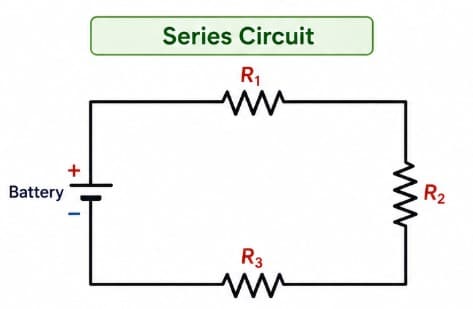
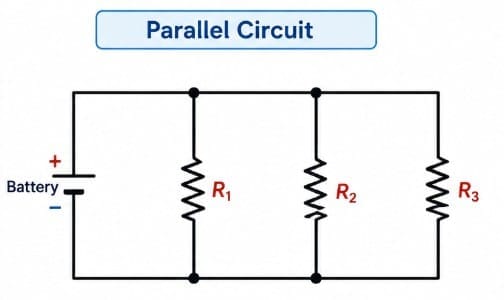
Electrical components such as resistors can be connected in different ways in a circuit. The two basic arrangements are series connection and parallel connection. The way the components are connected affects the flow of current and the potential difference across them. These arrangements are also important in practical electrical circuits.
Series Connection
In a series circuit, components are connected one after another, forming a single continuous path for current.
The same current flows through every component because there is only one path available for the charge to flow.
Important points
- Components are connected one after another.
- There is only one path for current.
- The same current flows through all the resistors.
- The potential difference is divided among the resistors.
- If one component is disconnected, the complete circuit is interrupted.
For resistors connected in series, the equivalent resistance is:
R = R₁ + R₂ + R₃
Parallel Connection
In a parallel circuit, components are connected in separate branches between the same two points. This provides more than one path for current.
The potential difference across each parallel branch is the same, while the total current divides among the different branches.
Important points
- Components are connected in separate branches.
- There is more than one path for current.
- The current divides among the branches.
- The potential difference across each branch is the same.
- If one branch is disconnected, current can still flow through the other branches.
For resistors connected in parallel:
1 / R = 1 / R₁ + 1 / R₂ + 1 / R₃
Series and Parallel Circuits: Comparison
| Series Connection | Parallel Connection |
|---|---|
| One path for current | More than one path for current |
| Same current flows through each resistor | Current divides among the branches |
| Potential difference is divided among the resistors | Same potential difference across each branch |
| If one component fails, the complete circuit is interrupted | Other branches can continue to operate |
| Equivalent resistance is the sum of the resistances | Equivalent resistance is less than the smallest individual resistance |
Applications
Parallel circuits are widely used in domestic wiring because electrical appliances can operate independently. For example, switching off a fan does not stop a light from working.
Series connections are useful in circuits where components need to be placed along the same current path.
Example : In a household electrical system, appliances are connected in parallel so that each appliance receives the required potential difference and can be switched on or off independently.
Remember :
- Series → one path → same current
- Parallel → multiple paths → same potential difference across each branch
6.Electrical Power and Energy
Electrical Energy
Electrical energy is the energy supplied by an electrical source or consumed by an electrical device. When an electrical appliance operates, electrical energy is converted into other forms of energy such as light, heat, sound or mechanical energy. The electrical energy used by a device depends on its power and the time for which it operates.
Formula : Electrical energy = Power × Time
E = P × t
Where:
- E = electrical energy
- P = electrical power
- t = time
Example : A 100 W bulb is used for 5 hours.
Electrical energy = 100 × 5 = 500 Wh
So, the bulb consumes 500 Wh or 0.5 kWh of electrical energy.
Electrical Power
Electrical power is the rate at which electrical energy is consumed or converted by an electrical device. The SI unit of electrical power is the watt (W).
Formula : P = E / t
In an electrical circuit, power can also be calculated using: P = VI
Where:
- P = electrical power
- V = potential difference
- I = current
Example : If an appliance operates at 230 V and draws a current of 2 A:
P = VI
P = 230 × 2
P = 460 W
Therefore, the power of the appliance is 460 W.
Watt and Kilowatt
The watt is the SI unit of power. Larger electrical appliances are commonly rated in kilowatts.
1 kilowatt (kW) = 1000 watts (W)
For example, a heater rated at 2 kW has a power of 2000 W.
Electrical Energy and Commercial Unit
The SI unit of electrical energy is the joule (J). For household electricity consumption, a larger unit called the kilowatt-hour (kWh) is commonly used.
1 kWh = 1 unit of electrical energy
Therefore, when an electricity bill shows the number of units consumed, it refers to the electrical energy measured in kilowatt-hours.
Example : If a 1 kW appliance operates for 3 hours:
Energy consumed = Power × Time
= 1 × 3
= 3 kWh
Therefore, it consumes 3 units of electrical energy.
Power Rating of Electrical Appliances
The power rating printed on an electrical appliance indicates the rate at which it consumes electrical energy when operating under its rated conditions.
| Appliance | Typical power rating |
|---|---|
| LED bulb | Low power |
| Electric fan | Moderate power |
| Refrigerator | Moderate power |
| Electric iron | Higher power |
| Electric heater | High power |
The actual power rating varies between different models and appliances.
Remember : Higher power does not always mean greater total energy consumption. The operating time also matters.
For example, a high-power appliance used for a short time may consume less energy than a low-power appliance used continuously for many hours.
Electricity Consumption
Electrical energy consumption depends on two main factors:
- Power of the appliance
- Time for which it is used
This relationship is useful for understanding household electricity bills.
Electrical energy consumed = Power × Time
7.Effects of Electric Current
When electric current flows through a conductor or an electrical device, it can produce different effects. The main effects of electric current are the heating effect, chemical effect and magnetic effect.
Heating Effect of Electric Current
When electric current passes through a conductor having resistance, electrical energy is converted into heat energy. This is called the heating effect of electric current.
The amount of heat produced depends on the current, resistance and time for which the current flows.
Applications
- Electric iron
- Electric heater
- Electric kettle
- Toaster
- Electric stove
- Incandescent electric bulb
Example : In an electric iron, current passes through a high-resistance heating element. The electrical energy is converted into heat, which is used for ironing clothes.
Remember : Electrical energy → Heat energy
Joule’s Law of Heating
Joule’s law gives the relationship between the heat produced and the factors affecting it. The heat produced is given by:
H = I²Rt
where H is the heat produced, I is the current, R is the resistance and t is the time.
From this relationship:
- More current → more heat produced
- Greater resistance → more heat produced
- Longer duration → more heat produced
Chemical Effect of Electric Current
When electric current passes through certain conducting liquids called electrolytes, it can produce chemical changes. This is known as the chemical effect of electric current.
The chemical effect may cause substances to be deposited on electrodes, gases to be released or the chemical composition of a solution to change.
Applications :
- Electroplating
- Extraction and purification of some metals
- Electrolysis
- Charging of certain types of cells
Example : In electroplating, an electric current is passed through a suitable electrolyte to deposit a thin layer of one metal over another object.
Remember : Electric current can produce chemical changes in suitable conducting liquids.
Magnetic Effect of Electric Current
A current-carrying conductor produces a magnetic field around it. This is called the magnetic effect of electric current. The magnetic effect is used in many electrical devices, including electromagnets, electric motors, relays and electric bells.
Example : An electromagnet is produced by passing electric current through a coil of wire, usually wound around a suitable magnetic material.
Important point : The magnetic effect of electric current is the basic principle behind several electrical devices and is studied in greater detail under the separate topic of magnetism.
Comparison of Effects
| Effect | What happens | Examples |
|---|---|---|
| Heating effect | Electrical energy is converted into heat | Electric iron, heater |
| Chemical effect | Chemical changes occur in suitable electrolytes | Electroplating, electrolysis |
| Magnetic effect | A magnetic field is produced around a current-carrying conductor | Electromagnet, motor, electric bell |
8.Cells and Batteries
An electric cell is a device that converts chemical energy into electrical energy. It provides a potential difference that can drive electric current through a closed circuit. Cells are widely used in portable electrical and electronic devices.
Electric Cell
A cell has two terminals, called the positive terminal and negative terminal. A chemical reaction inside the cell produces a potential difference between these terminals.
When the cell is connected to a closed circuit, it supplies electrical energy to the circuit.
Examples
- A dry cell used in a torch
- A cell used in a remote control
- A cell used in a wall clock
Primary Cells
Primary cells are cells that are generally designed for single use. Once the chemicals inside the cell are substantially used up, the cell cannot normally be recharged effectively. Common examples include ordinary dry cells and alkaline cells.
Features
- Used as a convenient portable source of electricity
- Generally not rechargeable
- Suitable for devices that require relatively small amounts of electrical energy
Secondary Cells
Secondary cells are rechargeable cells. Their chemical reactions can be reversed to a significant extent by supplying electrical energy from an external source. Common examples include lead-acid batteries and rechargeable lithium-ion batteries.
Features
- Can be recharged and used repeatedly
- Require an appropriate charging method
- Used in devices and systems that need repeated electrical energy
Primary and Secondary Cells
| Primary Cells | Secondary Cells |
|---|---|
| Generally used once | Can be recharged and used repeatedly |
| Normally not rechargeable | Rechargeable |
| Suitable for many low-power portable devices | Used where repeated use is required |
| Example: alkaline cell | Example: lead-acid battery |
Batteries
A battery is a combination of two or more cells connected together to provide electrical energy. In everyday usage, however, the term “battery” is also commonly used for a single packaged electrochemical cell, such as a small battery used in a remote control.
Batteries are available in different sizes and types depending on the device and the amount of electrical energy required.
Everyday Applications
| Type | Common applications |
|---|---|
| Primary cells | Remote controls, clocks, torches |
| Rechargeable cells | Mobile phones, laptops, cameras |
| Lead-acid batteries | Cars, inverters and backup power systems |
Remember
- Primary cell → generally not rechargeable
- Secondary cell → rechargeable
- A cell converts chemical energy into electrical energy.
9.Domestic Electricity and Electrical Safety
Domestic Electricity
Domestic electricity refers to the electrical supply used in homes to operate lights, fans, appliances and other electrical devices. A domestic circuit is designed to distribute electricity safely to different appliances.
In a typical domestic circuit, appliances are connected in parallel so that each appliance can operate independently.
Live, Neutral and Earth Wires
A domestic electrical connection generally uses three types of wires:
| Wire | Function |
|---|---|
| Live wire | Carries electrical current from the supply to the appliance |
| Neutral wire | Provides the return path for current to the supply |
| Earth wire | Provides a safe path for leakage current to the ground |
The earth wire is mainly a safety connection. It helps protect a person from electric shock if the metal body of an appliance accidentally becomes live.
Three-Pin Plug
A three-pin plug has three connections corresponding to the live, neutral and earth wires.
The earth connection is connected to the metal body of an electrical appliance where necessary. It provides protection against electric shock if there is an electrical fault.
Remember
- Live → supplies current
- Neutral → return path
- Earth → safety path
Earthing
Earthing is the process of connecting the exposed metal parts of an electrical appliance to the ground through a suitable conducting path.
If a fault causes the metal body of an appliance to become electrically charged, the earth connection provides a low-resistance path for the fault current. This helps reduce the risk of electric shock and allows protective devices such as a fuse or MCB to disconnect the circuit.
Example : If the insulation of a wire inside a metal-bodied appliance is damaged and the live wire touches the metal body, earthing provides a path for the fault current instead of allowing the current to pass through a person touching the appliance.
Fuse
A fuse is a safety device used to protect an electrical circuit from excessive current. It contains a thin fuse element that melts when excessive current produces enough heat.
When the fuse melts, the circuit is broken and the flow of current stops.
Important points
- A fuse protects a circuit from excessive current.
- It works on the heating effect of electric current.
- The fuse element has a relatively low melting point.
- A blown fuse must be replaced with a suitable fuse of the correct rating.
MCB
MCB stands for Miniature Circuit Breaker. It is a protective device that automatically switches off a circuit when excessive current flows, such as during an overload or short circuit. Unlike a fuse, an MCB can generally be reset after the fault has been corrected.
| Fuse | MCB |
|---|---|
| Fuse element melts when excessive current flows | Mechanism trips and opens the circuit |
| Must be replaced after it operates | Can generally be reset |
| Works using the heating effect | Uses an automatic switching mechanism |
| Provides overcurrent protection | Provides overcurrent and short-circuit protection |
Short Circuit
A short circuit occurs when current finds an unintended low-resistance path in an electrical circuit. This can cause a very large current to flow. A short circuit may result from damaged insulation, loose connections or contact between live and neutral conductors.
Effects
- Excessive current may flow.
- Wires may become overheated.
- Electrical equipment may be damaged.
- It may cause a fire if the fault is not interrupted.
Overloading
Overloading occurs when too many electrical appliances are connected to a circuit or when the total electrical load exceeds the safe capacity of the circuit. This causes excessive current to flow through the wires and may produce overheating.
Example : Connecting several high-power appliances to the same socket or circuit at the same time can cause overloading.
Electrical Safety Precautions
- Never touch electrical appliances with wet hands.
- Do not use damaged wires or plugs.
- Avoid overloading sockets and circuits.
- Use properly rated fuses and MCBs.
- Ensure that electrical appliances requiring protection are properly earthed.
- Switch off the power supply before carrying out electrical work.
- Keep electrical appliances away from water.
- Do not insert metal objects into electrical sockets.
10.Electricity – Quick Revision
This quick revision section brings together the important points covered in the Electricity study guide. It is useful for revising the topic quickly before an examination.
Important Definitions
| Term | Quick definition |
|---|---|
| Electricity | A form of energy associated with electric charges |
| Electric current | Rate of flow of electric charge |
| Electric circuit | A closed conducting path through which current can flow |
| Potential difference | Difference in electric potential between two points |
| Voltage | Common term for potential difference |
| Resistance | Property of a conductor that opposes the flow of current |
| Electrical power | Rate at which electrical energy is consumed or converted |
| Electrical energy | Energy supplied or consumed by an electrical device |
| Electric cell | Device that converts chemical energy into electrical energy |
| Fuse | Safety device that breaks a circuit when excessive current flows |
| MCB | Device that automatically disconnects a circuit when excessive current flows |
| Earthing | Connecting exposed metal parts of electrical equipment to the ground for safety |
Important Formulas
| Quantity | Formula |
|---|---|
| Electric current | I = Q / t |
| Potential difference | V = W / Q |
| Ohm’s law | V = IR |
| Current | I = V / R |
| Resistance | R = V / I |
| Series resistance | R = R₁ + R₂ + R₃ |
| Parallel resistance | 1/R = 1/R₁ + 1/R₂ + 1/R₃ |
| Electrical power | P = VI |
| Electrical energy | E = P × t |
| Joule’s law of heating | H = I²Rt |
Important Units
| Quantity | SI unit | Symbol |
|---|---|---|
| Electric charge | Coulomb | C |
| Electric current | Ampere | A |
| Potential difference | Volt | V |
| Resistance | Ohm | Ω |
| Electrical power | Watt | W |
| Electrical energy | Joule | J |
For household electricity consumption, electrical energy is commonly measured in kilowatt-hour (kWh).
1 kWh = 1 unit of electrical energy
Important Instruments
| Instrument | Measures | Connection |
|---|---|---|
| Ammeter | Electric current | Series |
| Voltmeter | Potential difference | Parallel |
Series and Parallel – Quick Comparison
| Series | Parallel |
|---|---|
| One path for current | Multiple paths for current |
| Same current flows through each component | Current divides among branches |
| Potential difference is divided | Same potential difference across each branch |
| If one component fails, the circuit is interrupted | Other branches can continue to operate |
| Used in suitable simple circuits | Commonly used in domestic wiring |
AC and DC
| DC | AC |
|---|---|
| Current flows in one direction | Current changes direction periodically |
| Commonly supplied by cells and batteries | Used in domestic electricity supply |
| Example: battery-operated device | Example: household mains supply |
Effects of Electric Current
| Effect | Main idea | Examples |
|---|---|---|
| Heating effect | Electrical energy produces heat | Iron, heater |
| Chemical effect | Current produces chemical changes in suitable electrolytes | Electrolysis, electroplating |
| Magnetic effect | Current produces a magnetic field | Electromagnet, motor |
Cells and Batteries
- A cell converts chemical energy into electrical energy.
- A primary cell is generally not rechargeable.
- A secondary cell is rechargeable.
- Batteries are used as portable sources of electrical energy.
- Rechargeable cells are used in devices such as mobile phones and laptops.
Domestic Electricity – Quick Revision
- Domestic appliances are generally connected in parallel.
- Live wire carries current from the supply.
- Neutral wire provides the return path.
- Earth wire provides a safety path.
- Three-pin plugs include live, neutral and earth connections.
- Earthing helps protect against electric shock.
- Fuse protects a circuit from excessive current.
- MCB automatically disconnects the circuit when excessive current flows.
Short Circuit and Overloading
| Short Circuit | Overloading |
|---|---|
| An unintended low-resistance path is formed | The electrical load exceeds the safe capacity of the circuit |
| Can cause a very large current | Causes excessive current and heating |
| May occur due to damaged insulation or contact between conductors | May occur when too many appliances are connected to a circuit |
| Can damage equipment and cause fire | Can overheat wires and equipment |
Important One-Line Facts
- Conventional current flows from positive to negative through the external circuit.
- Electron flow in a metallic conductor is from negative to positive.
- An ammeter is connected in series.
- A voltmeter is connected in parallel.
- Ohm’s law applies when temperature remains constant.
- A longer conductor generally has greater resistance.
- A conductor with a larger cross-sectional area generally has lower resistance.
- Domestic appliances are connected in parallel.
- Fuse operation is based on the heating effect of electric current.
- A current-carrying conductor produces a magnetic field around it.
- 1 kWh = 1 unit of electrical energy.
- 1 kW = 1000 W.
Everyday Applications
Electricity is used in:
- Homes
- Agriculture
- Industries
- Healthcare
- Education
- Communication
- Transport
- Household appliances
- Electronic devices
Further Reference Material:
NCERT – Class 10 Science, Chapter 11: Electricity
Official NCERT textbook chapter covering electric current, potential difference, Ohm’s law, resistance, heating effect and electrical power.