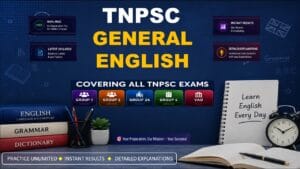
Practice this General English Grammar Quiz to improve your understanding of grammar basics and build a strong foundation in General English. This quiz covers important topics such as articles, tenses, sentence structure, and vocabulary that are commonly asked in competitive exams like SSC, RRB, and TNPSC. Regular practice of General English grammar questions will help you improve accuracy, confidence, and overall performance.
Note: Detailed explanations for all questions are provided below the test to help you learn from each answer and strengthen your TNPSC exam preparation

Concept Booster – General English Grammar Quiz
This General English Grammar Quiz concept booster focuses on strengthening your grammar basics and improving your understanding of General English concepts. It includes key topics like articles, tenses, parts of speech, and sentence formation that are essential for competitive exams. Use this section to revise important rules, avoid common mistakes, and perform better in English grammar MCQ questions.
🔹 Plural Forms
Plural forms are used to indicate more than one person, place or thing. In English grammar Basics, most nouns form their plural by adding -s or -es to the singular form (book → books, class → classes). However, some nouns follow special rules. Words ending in -y often change to -ies (city → cities), while nouns ending in -f or -fe may change to -ves (leaf → leaves).
There are also irregular plural forms that do not follow standard patterns. For example:
child → children
man → men
tooth → teeth
mouse → mice
Competitive exams frequently test irregular plurals in objective questions. A clear understanding of plural rules helps avoid common grammatical mistakes in sentence correction and fill in the blanks.
🔹 Articles (A, An, The)
Articles are determiners placed before nouns to clarify whether the noun is specific or general. There are three articles in English: a, an, and the.
“A” is used before words beginning with a consonant sound (a pen, a university).
“An” is used before words beginning with a vowel sound (an apple, an honest man).
“The” is used when referring to something specific or already known (the sun, the teacher).
Articles are commonly tested in SSC, RRB and TNPSC exams through error spotting and sentence correction questions. Many candidates make mistakes in choosing between “a” and “an” based on spelling instead of sound. Understanding correct article usage improves accuracy in grammar-based questions.
🔹 Tenses
Tenses indicate the time of an action and are formed by changing verb forms. The three main tenses are present, past and future, each with sub-types such as simple, continuous, perfect and perfect continuous.
For example:
Present – She writes daily.
Past – She wrote yesterday.
Present Perfect – She has written the exam.
Examinations often test tense consistency within a sentence. Errors occur when verbs are not used according to the correct time reference. A strong understanding of tense structure helps in solving cloze tests, sentence improvement questions and grammar-based objective questions efficiently.
🔹 Parts of Speech
Parts of speech classify words according to their function in a sentence. The main parts of speech include noun, pronoun, verb, adjective, adverb, preposition, conjunction and interjection.
- Noun – name of a person, place or thing
- Verb – shows action or state
- Adjective – describes a noun
- Adverb – describes a verb or adjective
Identifying parts of speech is essential for understanding sentence structure. Many competitive exams include direct questions asking candidates to identify the noun, verb or adjective in a sentence. Mastering this concept strengthens overall grammar skills.
🔹 Prepositions
Prepositions show the relationship between words in a sentence, especially in terms of time, place and direction. Commonly tested prepositions include in, on, at, for, since, by, and with.
“For” is used to show duration (for five years), while “since” is used to show a starting point (since 2020). Incorrect usage of prepositions is a frequent source of errors in competitive exams. Practicing preposition rules improves performance in fill in the blanks and error detection questions.
🔹 Synonyms and Antonyms
Synonyms are words with similar meanings, while antonyms are words with opposite meanings. Vocabulary-based questions appear regularly in government examinations.
For example:
Happy – Joyful (Synonym)
Big – Small (Antonym)
Strong vocabulary enhances comprehension skills and helps candidates perform better in reading passages and cloze tests. Regular practice of synonyms and antonyms builds confidence in the English section.
Quick Q&A Revision
- Plural of “Child”? → Children
- She ___ to school every day → goes
- Synonym of “Happy”? → Joyful / Glad
- Antonym of “Big”? → Small
- ___ apple a day keeps doctor away → An
- Past tense of “Write”? → Wrote
- Identify the noun → Name of person/place/thing (e.g., boy, school)
- Correct spelling → (Example: Beautiful / Necessary)
- This is the boy ___ won the prize → who
- Opposite of “Early”? → Late
- Verb in “She sings well”? → sings
- Comparative of “Good”? → Better
- I have lived here ___ 5 years → for
- Identify the adjective → Describing word (e.g., big, happy)
- Correct question form → (Example: Where are you going?)
Final Revision Tips (English Grammar Quiz)
- Focus on basic grammar rules like tenses, articles, and sentence structure
- Revise important topics such as nouns, verbs, adjectives, and pronouns
- Practice singular–plural forms and common irregular words (child → children)
- Learn commonly used synonyms and antonyms for vocabulary improvement
- Pay attention to correct sentence formation and question patterns
- Practice English MCQs daily to improve accuracy and confidence in exams
- Read simple sentences and identify parts of speech for better understanding
Further Reading:
For detailed grammar rules and additional explanations, refer to the Official British Council grammar guide